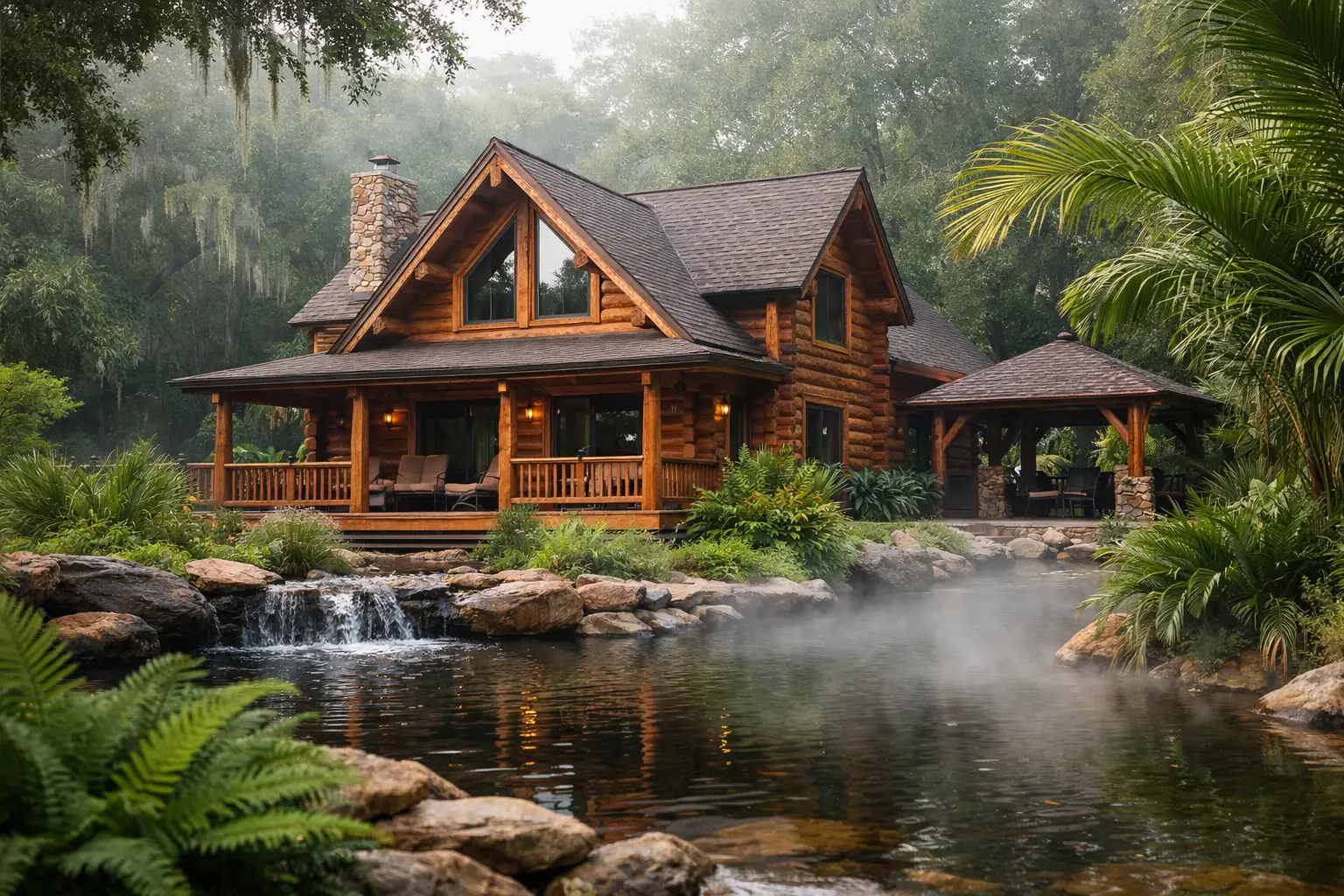
If you have ever watched a shaded porch stay damp long after the rain stops, you already understand the real test for log homes for humid climates. Moisture does not usually destroy a home overnight. It works slowly – through trapped water, poor airflow, soft wood, failed finishes, and small construction mistakes that turn into expensive repairs.
That is why the question is not whether a log home can work in the South. It can. The real question is what kind of log home, what species of wood, and what level of engineering will keep that home solid, attractive, and low maintenance for the long haul.
A lot of buyers love the look of a log home but assume humidity makes it a bad fit for places like Florida, coastal Georgia, or other warm, wet regions. That idea comes from seeing the wrong materials used in the wrong conditions. A log home built with moisture-prone wood, weak wall details, and little thought given to drainage will struggle. A log home designed for Southern weather is a different story.
What makes log homes for humid climates succeed
Humidity by itself is not the enemy. The real problems come from moisture that gets absorbed and stays trapped. In warm climates, that usually means repeated wetting from rain, poor roof overhangs, splash-back at the base of walls, condensation around mechanical systems, and shaded areas that never fully dry out.
Good log homes handle that with a combination of material choice, structural design, and practical detailing. The wood needs natural resistance to decay and insects. The home needs to shed water fast. Wall systems need to account for movement, settling, and sealing. And the entire structure needs to be engineered for wind and moisture exposure, not just made to look rustic in a brochure.
This is where many buyers get into trouble. They compare all log homes as if they are basically the same product. They are not. A pine package designed for a dry or cold climate is not automatically a smart choice for the Southeast. What works in the mountains does not always work near the coast or in a region with long wet seasons and year-round insect pressure.
Why wood species matters more than most buyers realize
If you are serious about long-term performance, the species of wood deserves close attention. Some woods simply hold up better in humid conditions than others. That is not sales talk. It is a maintenance issue, a durability issue, and over time, a cost issue.
Heart-cut cypress stands out because it naturally resists decay, moisture damage, and insects better than many common alternatives. That matters in humid climates where termites, high moisture levels, and fungal decay are not rare events. They are part of normal life.
By contrast, softer and less durable species often require more vigilance and more upkeep to stay ahead of problems. Can they be used? Sometimes, yes. But there is a trade-off. If the wood is less naturally resistant, the design, treatment, maintenance schedule, and overall margin for error all become more demanding.
For buyers who want an authentic log home look without signing up for constant worry, cypress makes practical sense. It gives you a better starting point. You still need proper design and care, but you are not fighting the climate with the wrong material from day one.
The design details that matter in humid climates
A good-looking log home can still be a poor humid-climate home if the design ignores water management. This is where experience shows. A well-designed home sheds water, stays ventilated, and avoids details that trap moisture where you cannot easily see it.
Roof overhangs are a good example. In a humid, rain-heavy climate, generous overhangs help protect walls, windows, doors, and porches from repeated wetting. They also reduce direct sun exposure on finishes, which can help coatings last longer. It is a simple feature, but it pays off year after year.
Elevating the home properly also matters, especially on sites with heavy rain, poor drainage, or coastal exposure. Keeping logs away from standing water, splash-back, and chronic dampness near grade is one of the most basic rules of durability. If that part is handled carelessly, even good materials can be put at a disadvantage.
Ventilation is another piece buyers sometimes overlook. Crawl spaces, roof systems, and covered porch areas need to be detailed so moisture does not sit and stagnate. Humid air is already part of the environment. The home should not be designed in a way that makes it easier for that moisture to collect and linger.
Engineering is not optional in the South
In some parts of the country, buyers focus mostly on appearance and floor plan. In the Southeast, that is not enough. Storm exposure changes the conversation. A true humid-climate log home should also be a wind-capable home.
That means engineering for hurricane-force winds, uplift, shear loads, fastening methods, and the way the entire structure performs under pressure. A beautiful log package with weak engineering is a gamble. It might look fine on paper and still fall short when weather gets serious.
This is especially important in Florida and other high-wind regions where code requirements are strict for good reason. Buyers should not be shy about asking how the home is engineered, what wind loads it is designed for, and whether the plans are prepared for local permitting and construction conditions.
The right answer is not always the cheapest answer up front. But rebuilding, repairing, or constantly maintaining a poorly suited home is rarely the cheaper path in the long run.
Maintenance is real, but it should be manageable
Anyone telling you a log home needs no maintenance at all is not giving you the straight story. Every wood home needs care. The honest question is how much care, how often, and how hard it is to stay ahead of issues.
For log homes in humid climates, maintenance should be reduced by good materials and smart design, not pushed entirely onto the homeowner after the sale. A decay-resistant species, proper overhangs, quality finishes, solid sealing details, and correct installation all work together to lower the maintenance burden.
That does not mean you ignore the home. It means inspections are simpler, finish schedules are more reasonable, and you are less likely to discover hidden deterioration after a few wet seasons. Buyers who want a weekend retreat, retirement home, or full-time residence usually appreciate that difference very quickly.
A low-maintenance log home is not a myth. But it usually comes from doing the hard thinking before construction starts, not from hoping a cheaper package will somehow outperform the climate.
Choosing the right builder support and package
The home itself is only part of the equation. The support behind it matters too. Some buyers want turnkey guidance with local builder coordination. Others want a material package and enough technical help to manage parts of the project themselves. Either route can work if the plans, materials, and support system are built around real-world construction.
What does not work well is a one-size-fits-all package sold by someone who does not understand Southern humidity, storm loads, or the permit process in tougher jurisdictions. That is where many buyers end up paying twice – once for the package and again for redesigns, fixes, or upgrades required later.
A company with real experience in humid, high-wind environments can help prevent those problems before they start. That includes plan design, engineering, material selection, and practical jobsite guidance. At Log Home Guys, that old-fashioned, direct approach still matters because buyers deserve real answers, not showroom talk and sales pressure.
Are log homes a smart choice for humid climates?
Yes, if they are built for the climate they are going into.
That is the plain truth. Log homes are not automatically bad for humid regions, and they are not automatically good either. It depends on the wood species, the structural engineering, the water-shedding design, and the quality of the support behind the project.
If you want the warmth and character of a true log home without taking on unnecessary risk, pay attention to what the house is made of and how it is meant to perform. In humid climates, pretty pictures are easy. Lasting performance takes better materials, better planning, and a builder who respects the conditions you actually live in.
That is the difference between owning a log home you enjoy and owning one you are always chasing with a paintbrush, a repair bill, or a worry you did not bargain for.